Two ways to stop paying full price for hot water
Both of these systems solve the same problem: water heating accounts for roughly 25% of a typical Perth household’s energy bill, and a conventional element is the most expensive way to do it.
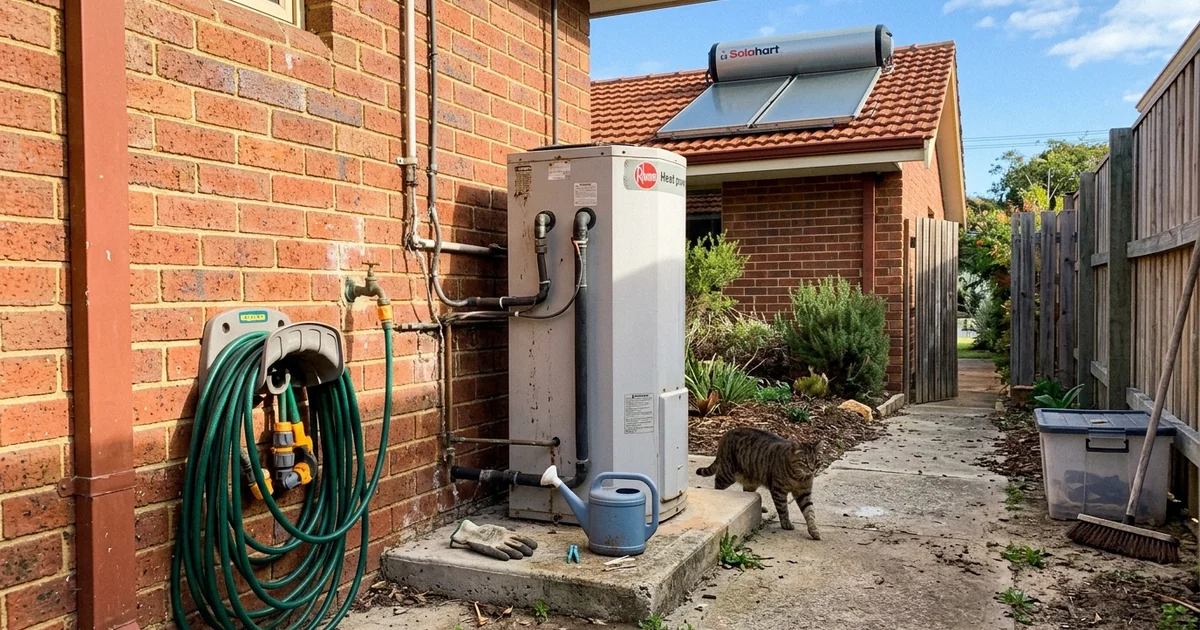
Solar thermal captures sunlight directly with roof-mounted collectors and transfers that heat into water. Most of the energy is free.
Heat pump extracts heat from ambient air using a refrigeration cycle, delivering roughly three units of heat for each unit of electricity consumed. Our guide on how heat pump hot water works walks through that cycle in detail.
Both cut the hot water portion of your bill dramatically. Both attract federal Small-scale Technology Certificates. The choice between them comes down to your property, not to which technology is better in the abstract.
The comparison
| Heat pump | Solar thermal | |
|---|---|---|
| Installed cost | $2,500 - $5,500 before STC | $2,500 - $6,500 before STC |
| STC rebate | Yes | Yes |
| Roof work required | None | Collectors, sometimes tank |
| Roof orientation matters | No | Critically |
| Shading matters | No | Critically |
| Structural loading | None on the roof | Significant for close-coupled |
| Works with existing PV | Excellent, time it to generation | Competes for the same roof space |
| Noise | Low hum while running | Silent, or a small pump on split |
| Cold-weather performance | Good, backup element as fallback | Good, booster covers shortfall |
| Typical lifespan | 10 - 15 years | 15 - 20 years, collectors longer |
| Maintenance items | Compressor, fan, anode | Pump, controller, booster, frost valve, anode |
When solar wins
You have unshaded north-facing roof space that is not full of PV. This is the decisive condition. Perth’s sun hours are among the best of any Australian capital, and a well-oriented collector array here performs genuinely well.
Your roof can carry the load. For a close-coupled system with the tank on the roof, structural capacity matters. A split system avoids this at higher cost.
You want the longest service life. Collectors regularly outlast heat pump compressors, often reaching 20 years or more.
You have mains gas for boosting. A gas booster is cheap to run and recovers quickly, which makes the total running cost very low.
When a heat pump wins
Your roof is shaded, poorly oriented, or already covered in PV. Increasingly the common case. A heat pump sits at ground level and does not care what the roof looks like.
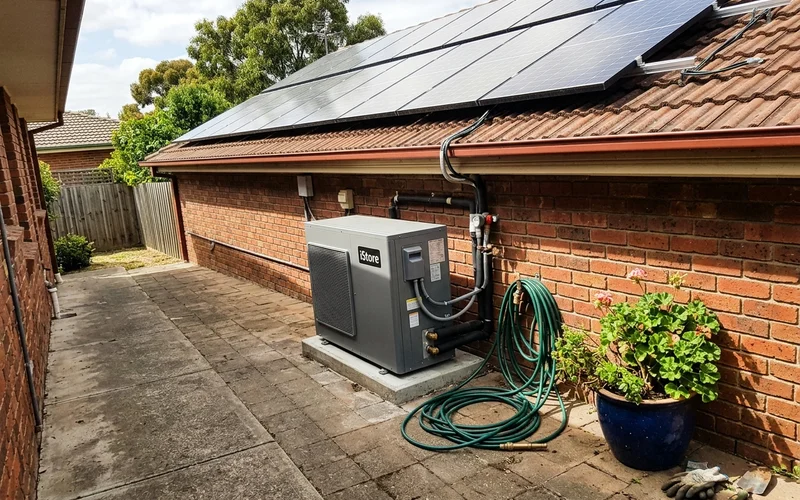
You already have rooftop PV. This is the strongest pairing available. Set the heat pump’s timer to run during your generation window and most of the electricity it draws is your own. Solar thermal would compete for the same roof space that is already earning you generation.
You want a simpler installation. No roof access, no collectors, no flashing, no structural assessment. Usually a faster job and often a lower installed cost.
You are in a location where roof work is awkward. Two-storey homes, difficult access, or heritage roof materials all add cost and complication to solar.
You want to avoid roof penetrations entirely. Some people simply prefer not to add plumbing penetrations to a roof, and that is a reasonable position.
Where they are genuinely comparable
Running cost, in practice, is closer than the theory suggests. Solar uses free energy but needs boosting on cloudy days and short winter days. A heat pump uses purchased electricity but very little of it. Across a Perth year, both land in similar territory and both are dramatically cheaper than electric storage or continuous flow gas.
Rebate treatment is the same in kind. Both are eligible for federal STCs, with the value varying by model’s deemed savings. Western Australia has no state rebate, so the federal certificate is the mechanism for both.
Neither is fragile. Both are mature technologies with established brands and local parts support.
Our general advice
If you have good, unshaded, north-facing roof space that is not already occupied by PV panels, and the structure supports it, solar hot water is an excellent choice in Perth and will likely outlast the alternative.
If your roof is shaded, congested, awkward or already earning its keep with PV, a heat pump gives you comparable savings without any of the roof constraints, and it pairs beautifully with generation you already have.
If you are unsure, the assessment takes about fifteen minutes on site. We quote both where both are viable, with the STC rebate already deducted, so you can compare like with like. See our heat pump hot water and solar hot water pages for what each installation involves.