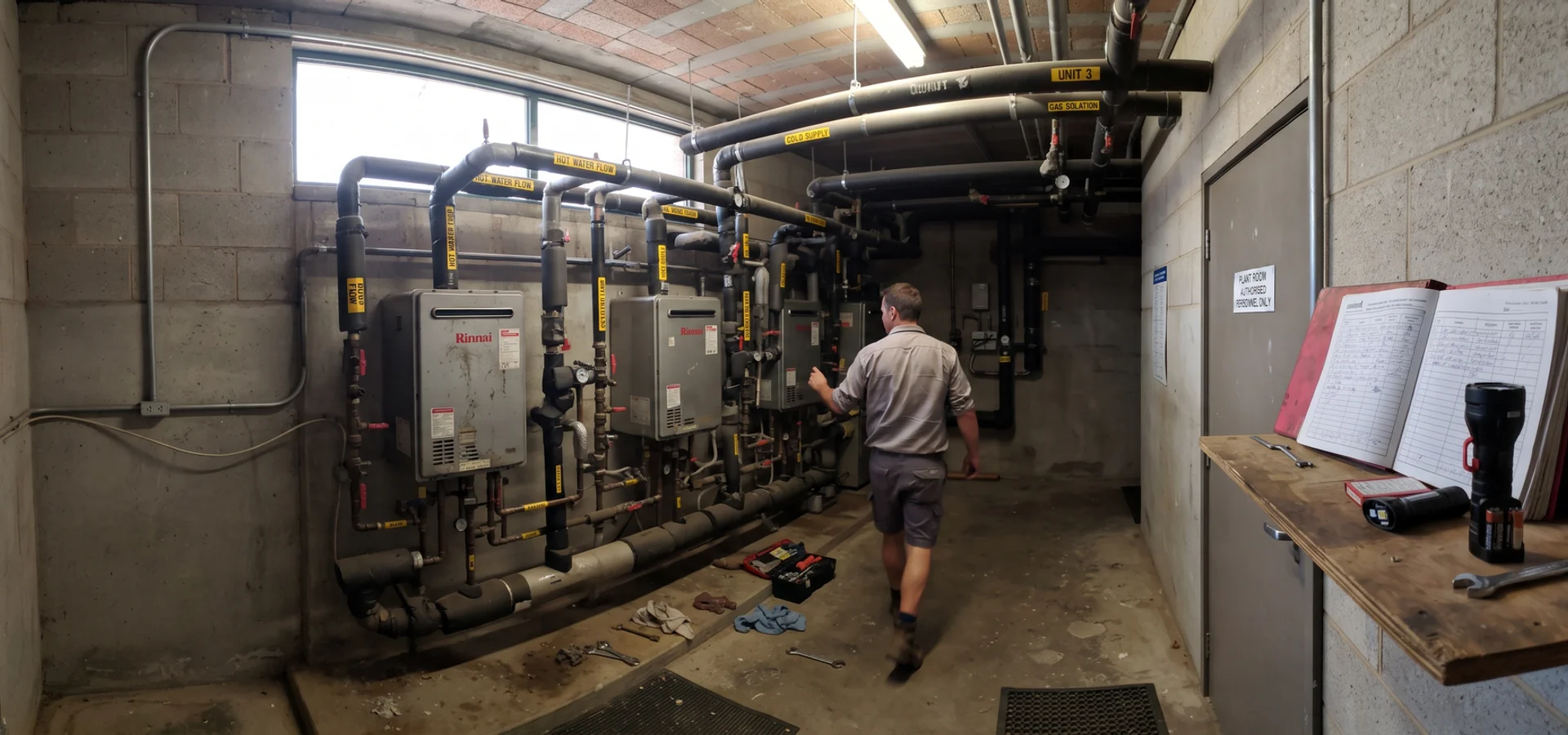
Hot water for buildings, not just houses
We deliver large-scale hot water solutions for Perth developments, body corporates and commercial properties, from capacity and redundancy planning through to thermostatic mixing valve compliance under AS/NZS 3500.4 and ongoing maintenance agreements.
Commercial hot water is a different problem to residential, and it draws on the same licensed trade base as our residential hot water system Perth work. A domestic failure is an inconvenience for one household. A plant room failure in a 40-unit apartment block is a building full of cold showers, a flood of calls to the strata manager, and an emergency spend that was never in the budget. The work is therefore less about the units themselves and more about capacity modelling, redundancy, compliance records and planning renewals before they become emergencies.
Compliance is the baseline
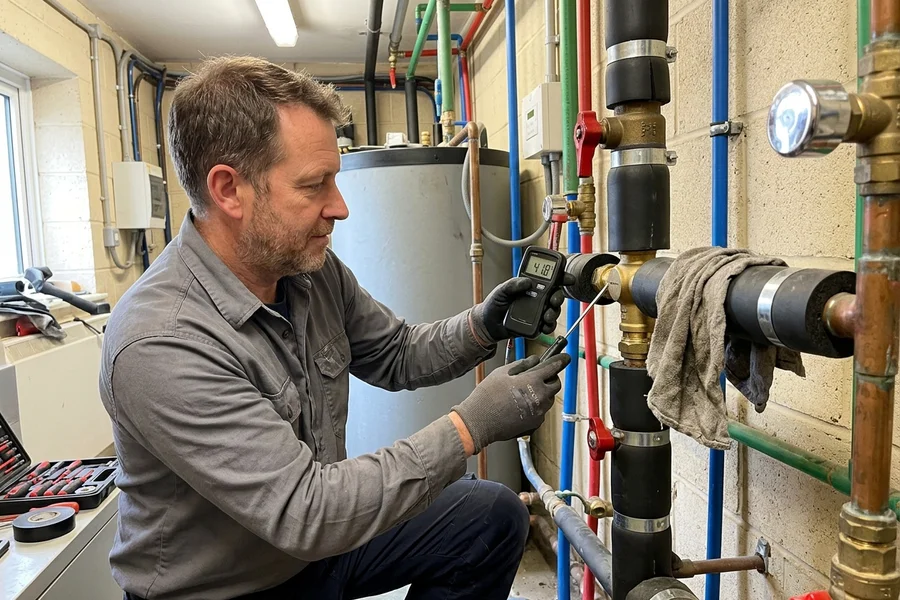
Under AS/NZS 3500.4, hot water must be stored at 60C or above to control Legionella, while being delivered at a maximum of 50C to personal hygiene outlets, and 45C in healthcare, aged care and childcare facilities. Reconciling those two requirements is the job of a tempering valve or, in higher-risk settings, a thermostatic mixing valve (TMV).
TMVs in healthcare, aged care and childcare facilities require annual testing and servicing with records kept. We carry out that testing, document the results, and provide a written report in a format that goes straight into a committee agenda or an audit file.
Capacity and redundancy planning
We model peak simultaneous demand across the dwellings or fixtures rather than simply adding up nominal fixture counts, which tends to produce plant that is either wastefully oversized or embarrassingly short at 7am. Then we build in tolerance, so the loss of a single unit degrades service rather than eliminating it.
Manifolded banks of continuous flow units suit buildings with variable demand and give natural redundancy. Large storage cylinders with good recovery suit buildings with sharp morning peaks. Many sites end up with a hybrid. The right answer depends on the building, the plant room space, the available gas or electrical supply, and how the committee wants to stage capital spend.
Staged replacement without emptying the building
Nobody wants a building-wide shutdown. We schedule replacements in stages so only part of the site is offline at a time, run changeovers after hours where required, and give strata managers written notice periods they can circulate in advance. On larger renewals we work to a multi-year plan so the spend is predictable rather than reactive.
Maintenance agreements
A maintenance agreement covers scheduled preventative servicing, an asset register with expected renewal dates, TMV and compliance testing records, and priority emergency dispatch. For buildings where a failure affects many residents or interrupts trading, that priority response is usually the whole point.
Talk to us about a site assessment. For related reading, see our guide on body corporate and commercial hot water compliance and tempering valve and TMV testing in Perth. For urgent plant failures, our 24/7 emergency service covers commercial sites as well as homes.