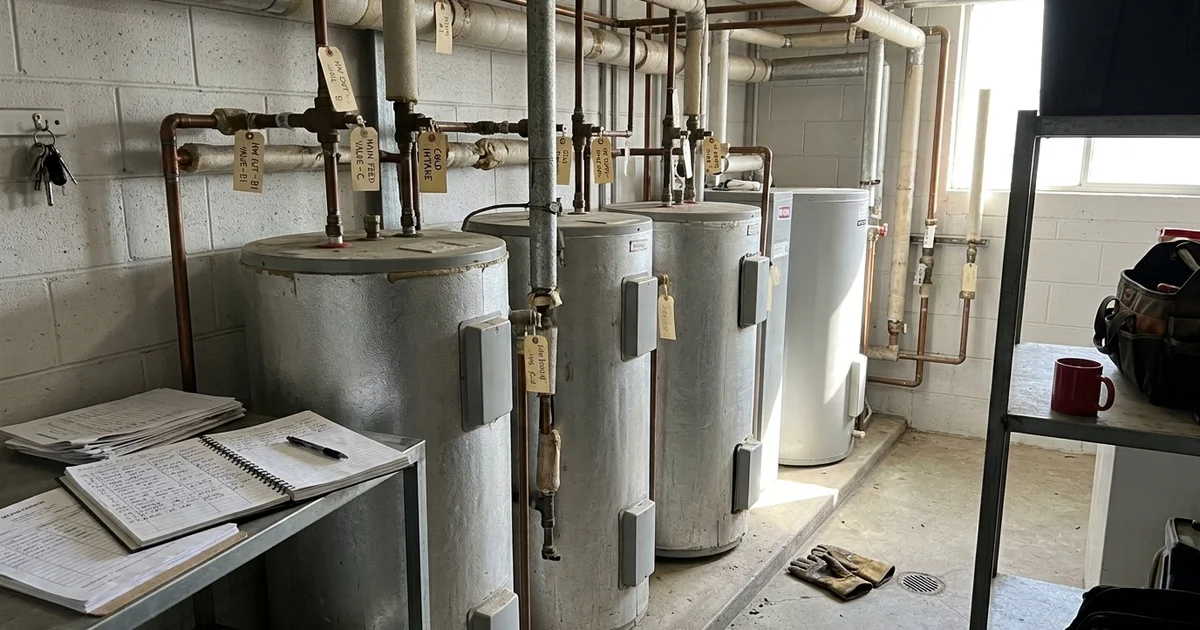
Why commercial hot water is a different problem
In a house, a hot water failure is an inconvenience for one household. In a 40-unit apartment block, it is a building full of cold showers, a flood of calls to the strata manager, and an unbudgeted emergency spend.
That difference reshapes the whole job. Commercial and body corporate hot water is less about which unit you buy and more about capacity modelling, redundancy, compliance documentation and planning renewals before they become emergencies.
The buildings that handle this well have three things: an accurate asset register, a compliance testing cycle that actually happens, and a funded replacement plan that runs ahead of failure rather than behind it. That is the approach we take to commercial hot water across the Perth metro.
The compliance baseline
AS/NZS 3500.4 sets the framework, and it resolves a genuine tension between two safety requirements.
Store at 60C or above. Legionella bacteria can proliferate in warm water. Maintaining storage temperature at 60C or higher controls that risk. This is not optional in shared or commercial facilities.
Deliver at 50C maximum. Water at 60C causes a serious scald in around five seconds. Personal hygiene outlets must therefore be limited to 50C. In healthcare, aged care and childcare settings the limit drops to 45C.
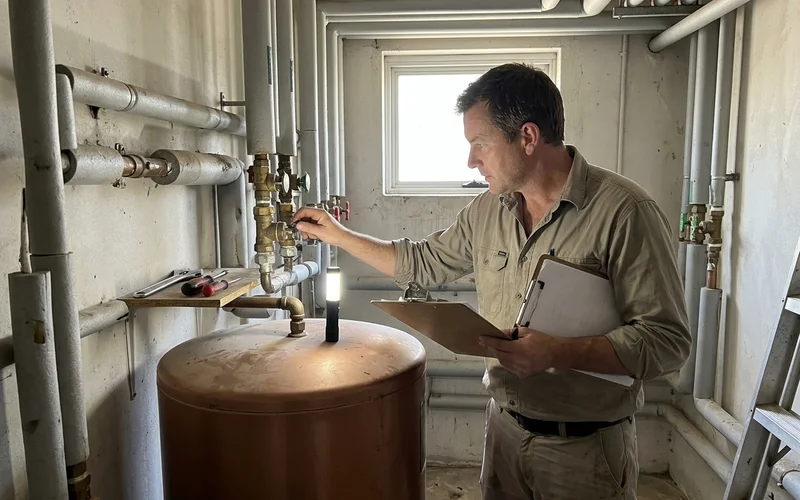
Reconciling the two requires a tempering valve or, in higher-risk settings, a thermostatic mixing valve. A TMV responds faster and holds temperature more precisely, and critically it fails safe by shutting down flow if the cold supply is lost rather than passing full-temperature water to the outlet.
Annual TMV testing is required in healthcare, aged care and childcare facilities, with records kept. We carry out that testing and provide written documentation suitable for an audit file or a committee agenda. Our guide on tempering valve and TMV testing goes into the detail.
Capacity and redundancy
The common mistake on multi-dwelling buildings is sizing by adding up nominal fixture counts. That produces plant that is either wastefully oversized or embarrassingly short at 7am on a weekday.
Better practice is modelling peak simultaneous demand: how many showers genuinely run at once in this building, at what time, and how quickly the system needs to recover between peaks.
Then comes redundancy, which is the part most often missing. A single point of failure in shared plant means one component failing takes the entire building offline. Designing so that the loss of one unit degrades service rather than eliminating it costs more upfront and saves enormously the first time something fails.
Manifolded continuous flow banks suit buildings with variable demand and give natural redundancy, since one unit down still leaves the others operating.
Multiple storage cylinders suit buildings with sharp morning peaks and give a large volume available instantly.
Many sites end up with a hybrid. The right answer depends on the building, the plant room space, the available gas or electrical supply, and how the committee wants to stage capital expenditure.
Staged replacement
Nobody wants a building-wide shutdown, and a committee that approves one will hear about it.
Staged replacement means scheduling works so only part of the building is offline at any time, running changeovers after hours where required, and issuing written notice periods that the strata manager can circulate in advance. On larger renewals we work to a multi-year plan so the spend is predictable rather than reactive.
The other advantage of staging is budget. Replacing an entire plant room in one financial year is a large special levy. Replacing it across three years, prioritised by asset condition, is a manageable line item.
Maintenance agreements
A maintenance agreement typically covers:
- Scheduled preventative servicing on an agreed cycle
- An asset register with expected renewal dates
- TMV and compliance testing with written records
- A prioritised defect list after each inspection
- Priority emergency dispatch when something does fail
- Budget forecasting to support committee planning
For buildings where a hot water failure affects many residents or interrupts a trading business, the priority response alone usually justifies the agreement. Everything else is the difference between managing an asset and reacting to it.
What a site assessment involves
We inspect the existing plant, record the asset list with ages and conditions, measure delivery temperatures at representative outlets, check TMV compliance status, and identify any immediate safety or compliance gaps.
You get a written report covering current condition, compliance status, a prioritised defect list and indicative costs, formatted so it can go straight into a committee agenda.
For the full service, see our commercial hot water page. Urgent plant failures are covered by the same 24/7 dispatch we run for residential work across the Perth metro.