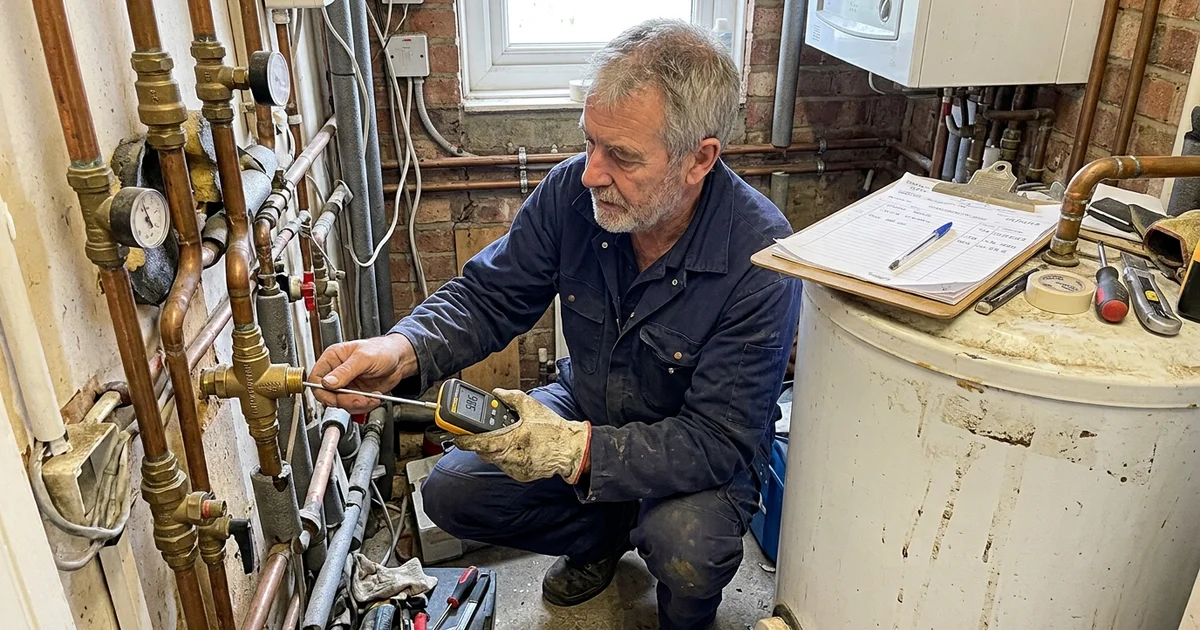
Two requirements that pull in opposite directions
Australian hot water compliance solves a genuine tension. Water needs to be stored hot enough to prevent bacterial growth, and delivered cool enough not to scald anyone.
Storage at 60C or above. Legionella bacteria can proliferate in warm water. Storing at 60C or higher keeps that under control. This is why turning your thermostat down to save energy is not the free win it appears to be. A valve that weeps rather than drifts is a different problem — see hot water leaking from the bottom for that.
Delivery at 50C maximum. Water at 60C causes a serious scald in about five seconds. At 50C it takes minutes. In healthcare, aged care and childcare settings the limit drops to 45C, because the people using those outlets may be less able to react quickly.
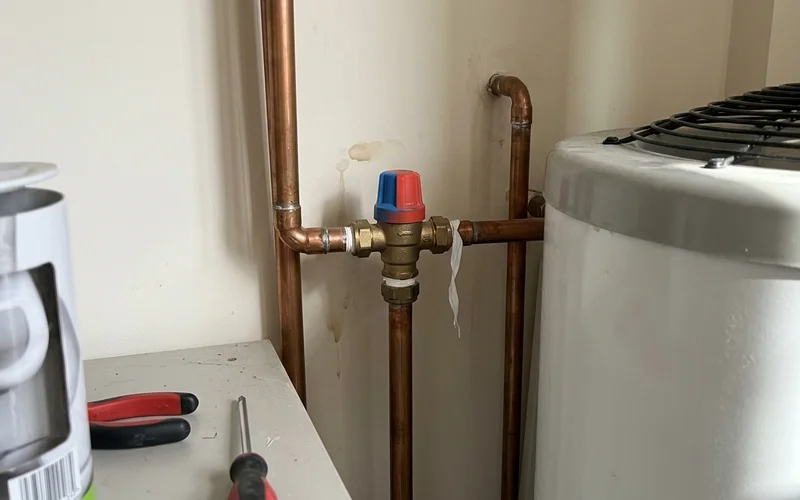
The device that reconciles these is a tempering valve or, in higher-risk settings, a thermostatic mixing valve. It sits after the hot water system and blends stored hot water with cold to deliver a controlled temperature at the outlet. Both requirements are set out in AS/NZS 3500.4. A failed valve is one of the faults our emergency hot water repairs team attends most often, in both directions.
Tempering valve versus thermostatic mixing valve
| Tempering valve | Thermostatic mixing valve (TMV) | |
|---|---|---|
| Where used | Most residential installations | Healthcare, aged care, childcare, some commercial |
| Accuracy | Adequate for domestic use | Tighter tolerance, faster response |
| Response to supply change | Slower | Fast fail-safe shutdown |
| Testing requirement | Check at service | Annual test and service with records |
| Cost | Lower | Higher |
| Typical set point | 50C | 45C in high-risk settings |
A tempering valve is a thermostatic device using a wax or bi-metal element to modulate the hot and cold inlets. It does the job well in a house.
A TMV is a more sophisticated version. It responds faster to changes in supply pressure or temperature, and critically it will fail safe by shutting down flow if the cold supply is lost, rather than allowing full-temperature water through to the outlet. That fail-safe behaviour is why it is mandated where vulnerable people are involved.
Signs your tempering valve is failing
Tempering valves are consumable components. They drift, seize and fail, generally somewhere between five and ten years.
Hot water is suddenly not hot enough anywhere. A classic. People assume the hot water system has failed when the valve has drifted and is blending in too much cold.
Hot water is dangerously hot at the tap. The more serious direction. If the valve has failed open on the hot side, you may be getting stored water at 60C or above straight to the outlet.
Temperature fluctuates while showering. Particularly when another outlet is used, which points at a valve no longer holding its set point under changing pressure.
No valve at all. Older installations sometimes predate the requirement. If your system was installed a long time ago and has never been touched, it is worth checking one is fitted.
Testing is done with a thermometer at the outlet, not by hand. Hands are unreliable thermometers, particularly in winter when everything feels hotter than it is.
Who needs annual TMV testing
Facilities where TMVs are installed to protect vulnerable users require annual testing and servicing, with records kept:
- Hospitals and medical centres
- Aged care facilities and nursing homes
- Childcare centres and early learning facilities
- Schools with young children, depending on the setting
- Some disability accommodation and supported living
The test verifies delivery temperature, checks the fail-safe cold-supply-loss shutdown, and confirms the valve responds correctly. Results are documented and the report retained for audit.
We carry out this testing across the Perth metro and provide written records suitable for an audit file or a committee agenda. For buildings with multiple valves, an asset register makes the annual cycle far easier to manage, which we cover on our commercial hot water page.
Where this fits in a normal household
For a standard Perth home there is no mandated annual test, but the valve is worth checking as part of a regular hot water service, because it fails quietly and in both directions.
We replace or reset tempering valves as part of every new installation, and check delivery temperature at an outlet before handing over. If your hot water has recently become lukewarm at every tap with no other symptoms, the valve is a strong first suspect and it is a straightforward repair.
If your hot water has become unpredictably hot, treat that as urgent rather than an annoyance. Our emergency hot water repairs team covers valve faults 24/7 across the metro, and a scald risk is worth acting on quickly.