The basic principle
Solar hot water does something conceptually simple: it puts water where the sun can heat it, then stores the result until you need it.
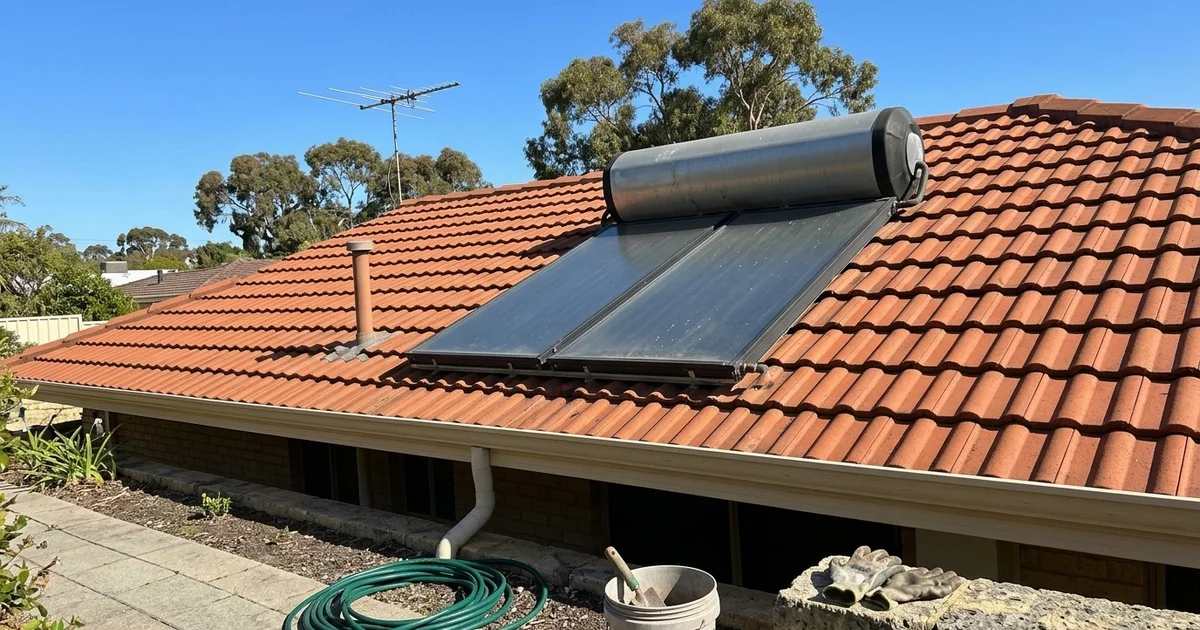
Collectors mounted on the roof absorb solar radiation and convert it to heat. Water circulating through those collectors picks up that heat and carries it to an insulated storage tank. When you open a hot tap, you draw from that tank exactly as you would from any storage system.
The only genuinely new component is the collector array. Everything downstream, the tank, the tempering valve, the pipework, works the same way as a conventional storage system.
Because the sun does not shine on demand, every solar system also has a booster: a gas burner or an electric element that tops up the tank when solar input has not been sufficient. That is what stops a run of cloudy days turning into cold showers.
Close-coupled versus split
There are two ways to arrange the tank relative to the collectors, and it is the main structural decision.
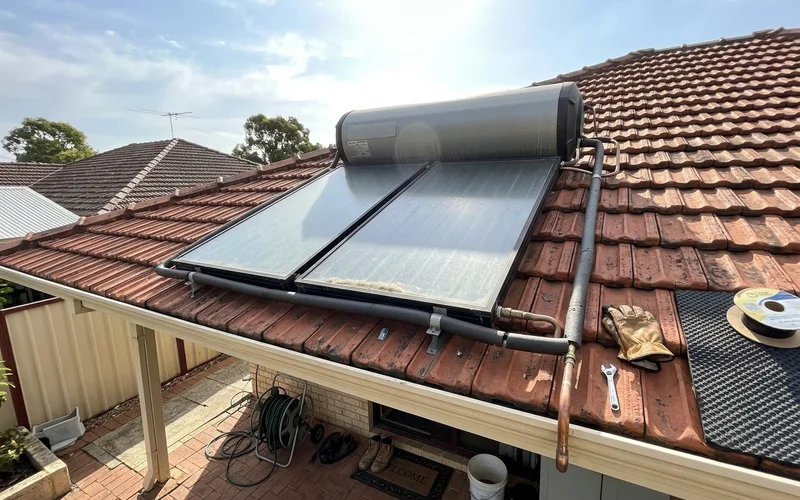
Close-coupled thermosiphon puts the storage tank on the roof, sitting horizontally directly above the collectors. It works on natural convection: water heated in the collectors becomes less dense, rises into the tank, and cooler water flows down to replace it. No pump, no controller, no electricity needed for circulation.
The advantages are simplicity and lower cost. The disadvantage is weight. A full tank on a roof is a serious load, and not every Perth tile roof should carry one without assessment.
Split systems keep the tank at ground level and use a small circulation pump with a controller. The controller compares collector temperature to tank temperature and runs the pump only when there is useful heat to move.
Split costs more and adds two components that can fail. In return, the roof carries only the collectors, the tank is out of the weather, and servicing does not require roof access. On many Perth homes it is the better answer.
Flat plate versus evacuated tube
Flat plate collectors are a glazed, insulated box containing an absorber plate and a network of tubes. Robust, cost-effective and well proven in Australian conditions. They are the volume choice for most Perth installations.
Evacuated tubes use rows of double-walled glass tubes with a vacuum between the layers. The vacuum is an excellent insulator, so heat losses to cold ambient air are much lower. They perform better on cold mornings and in shoulder seasons, and they suit properties in the hills and outer eastern suburbs where overnight temperatures drop further.
Evacuated tubes cost more. Whether they are worth it depends on how much you care about winter and early-morning output.
Boosting, and why commissioning matters
Every solar system has a booster. Gas boosting suits homes with mains natural gas and is generally cheaper to run. Electric boosting suits homes without gas and can be set to run on an off-peak tariff.
The thing that separates a good solar installation from a mediocre one is how the booster is configured. Set it to fire too eagerly and it tops the tank up before the sun has had a chance to do the work, which quietly turns an expensive solar system into an ordinary gas or electric one. Set it correctly and it only engages when solar genuinely has not delivered.
This is worth checking at every service, and it is one of the first things we look at when someone tells us their solar system does not seem to be saving them anything.
Why Perth is well suited
Perth receives among the highest annual sun hours of any Australian capital city. Solar hot water is not a marginal proposition here in the way it can be in colder, cloudier climates.
Winter still matters. Days are shorter, inlet water is colder, and there are genuinely overcast stretches. That is what the booster is for, and a properly sized system with correct boosting handles it without anyone noticing.
Frost protection is the other local consideration. Coastal Perth rarely freezes, but the hills and outer eastern suburbs do drop lower overnight. Systems installed here include frost protection, either a frost valve or a controller-driven circulation strategy, and it is worth verifying at each service.
Maintenance
The collectors themselves are largely maintenance-free, and commonly last 15 to 20 years or more. What needs attention is everything else: the circulation pump and controller on a split system, the booster, the frost protection valve, and the sacrificial anode rod in the tank.
That last one matters in Perth. The tank on a solar system is a steel cylinder holding heated water, exactly like any other storage system, and Perth’s harder water consumes anodes faster than manufacturers assume. Checking it roughly every five years is what pushes a tank toward the collectors’ lifespan rather than failing well short of it.
For installation, repairs and servicing across the Perth metro, see our solar hot water page. If you are weighing up whether it stacks up financially, read is solar hot water worth it in Perth.