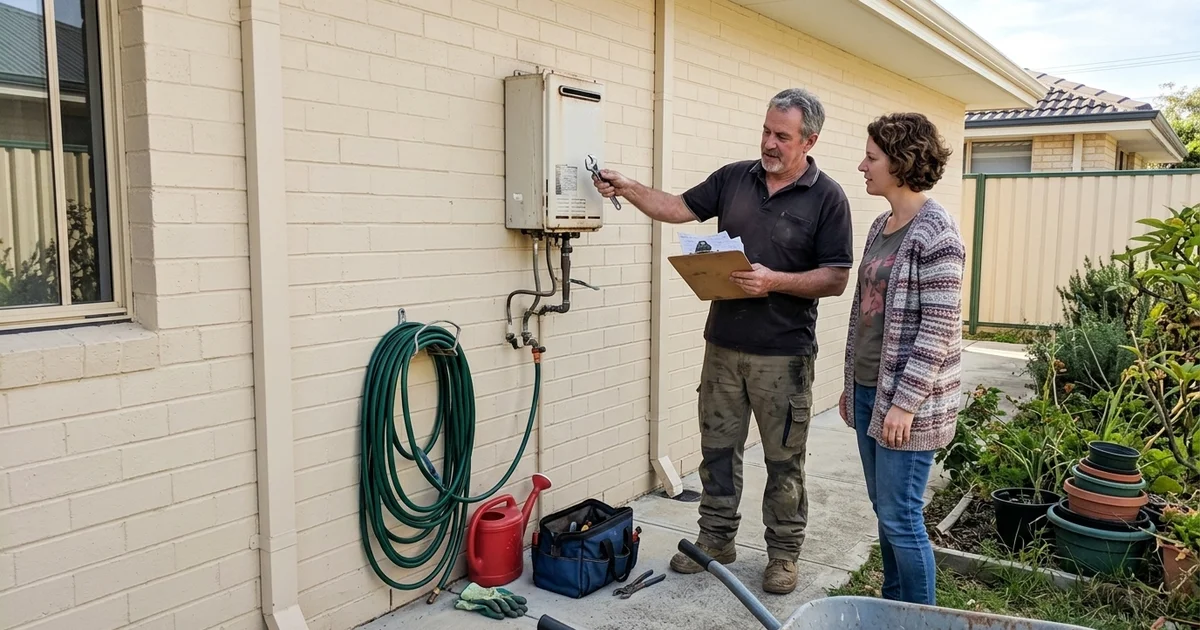
Start with what your property can actually take
Before comparing running costs or brands, work out which options are genuinely available at your address. This eliminates half the decision in about a minute, and it is the first thing we check on a hot water system installation quote.
Do you have mains natural gas? A gas meter connected to a street main opens up gas storage and continuous flow. Gas bottles mean you are on LPG, which works but costs more per unit of energy. No gas at all rules both out unless you want to fund a connection.
Do you have unshaded north-facing roof space? Solar thermal hot water needs collectors on a roof section that gets clear sun through the middle of the day, and a structure that can carry the load if you want a close-coupled system with the tank up there too. A roof already covered in PV panels usually rules solar hot water out on space alone.
Do you have somewhere outdoors with clear airflow? Heat pumps need air movement around the fan and a spot that is not directly under a bedroom window. Most properties have one, but it is worth identifying before you commit.
What is your electrical supply like? Instantaneous electric for a whole house draws a lot of power and often needs switchboard work. Heat pumps and standard storage tanks do not.
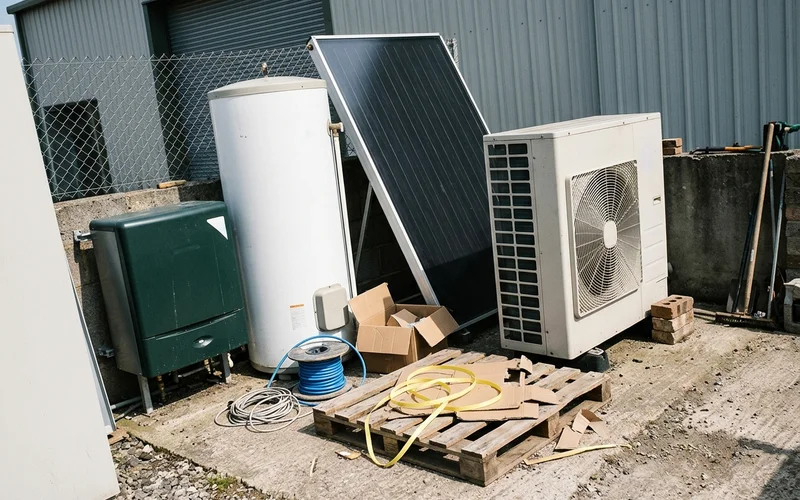
The four types, honestly compared
| Upfront cost | Running cost | Space needed | Best for | |
|---|---|---|---|---|
| Electric storage | Lowest | Highest | Tank footprint | Small budgets, off-peak households |
| Gas storage | Low | Moderate | Tank plus clearances | High simultaneous demand on mains gas |
| Continuous flow gas | Moderate | Moderate, no standby loss | Small wall space | Mains gas homes wanting endless hot water |
| Solar | High before rebate | Very low | Roof collectors plus tank | Good north-facing roof, sunny sites |
| Heat pump | High before rebate | Very low | Ground-level pad with airflow | Almost everyone, especially with PV |
Electric storage is the cheapest to buy and install and the most expensive to run. It works anywhere there is power, which is its main virtue. On a genuine off-peak tariff with a correctly sized tank it can be reasonable, but it is rarely the best long-term value in 2026.
Gas storage recovers faster than electric, so it needs less stored volume for the same household. It still loses heat through the cylinder walls around the clock.
Continuous flow gas heats on demand, never runs out, takes up almost no space and has no standby losses. The constraint is flow rate, so it needs sizing on simultaneous outlets rather than household size.
Solar uses free sunshine and performs exceptionally well in Perth’s sun hours. It needs a booster for cloudy stretches and high-demand days, and it needs suitable roof access.
Heat pump moves heat from ambient air rather than generating it, so it delivers the same hot water on roughly a third of the electricity. It works at ground level, needs no roof work, and pairs beautifully with rooftop PV.
Household size and demand pattern
Once you know what is possible, size on your actual peak demand.
For storage systems, that means litres. Roughly 125 to 170 litres of electric storage suits a family of four on a continuous tariff, while the same family on off-peak needs 250 to 315 litres because all the heating happens overnight. Gas storage needs less volume than electric because it recovers faster.
For continuous flow, that means litres per minute. Around 16 L/min for a one-bathroom home, 20 L/min for a typical two-bathroom family, 26 L/min where multiple showers genuinely run at once.
The mistake to avoid is buying headroom for its own sake. An oversized storage tank radiates heat every hour of every day for a decade, and you pay for all of it.
Upfront versus lifetime cost
This is where most decisions actually get made, and where the cheapest quote often is not the cheapest system.
Water heating accounts for roughly 25% of a typical Australian household’s energy bill. Over ten years, the difference between the highest and lowest running cost options on that quarter of the bill dwarfs the difference in purchase price.
The federal Small-scale Technology Certificate scheme narrows the upfront gap considerably. Eligible heat pump and solar systems attract a point-of-sale discount, typically $800 to $1,500 or more depending on model. Western Australia has no separate state rebate, so the STC is the one that matters here. After it, an entry-level heat pump often lands close to the cost of a good electric storage tank while costing a fraction to run.
For the full ten-year picture across all four types, see our guide on hot water running costs compared.
A quick decision path
- Have mains gas, want endless hot water, limited space? Continuous flow gas.
- Have mains gas, several showers at once, want low upfront cost? Gas storage.
- Have clear north-facing roof and no PV in the way? Solar with the right booster.
- Have rooftop PV, or a shaded or congested roof? Heat pump.
- Tight budget, small household, off-peak tariff available? Electric storage, sized properly.
- Not sure? Get someone to look at the property. Ten minutes on site removes the guesswork.
We size, quote and install all five options across the Perth metro. See our hot water system installation page for what a compliant install includes, including free old-tank removal and the STC rebate applied upfront.