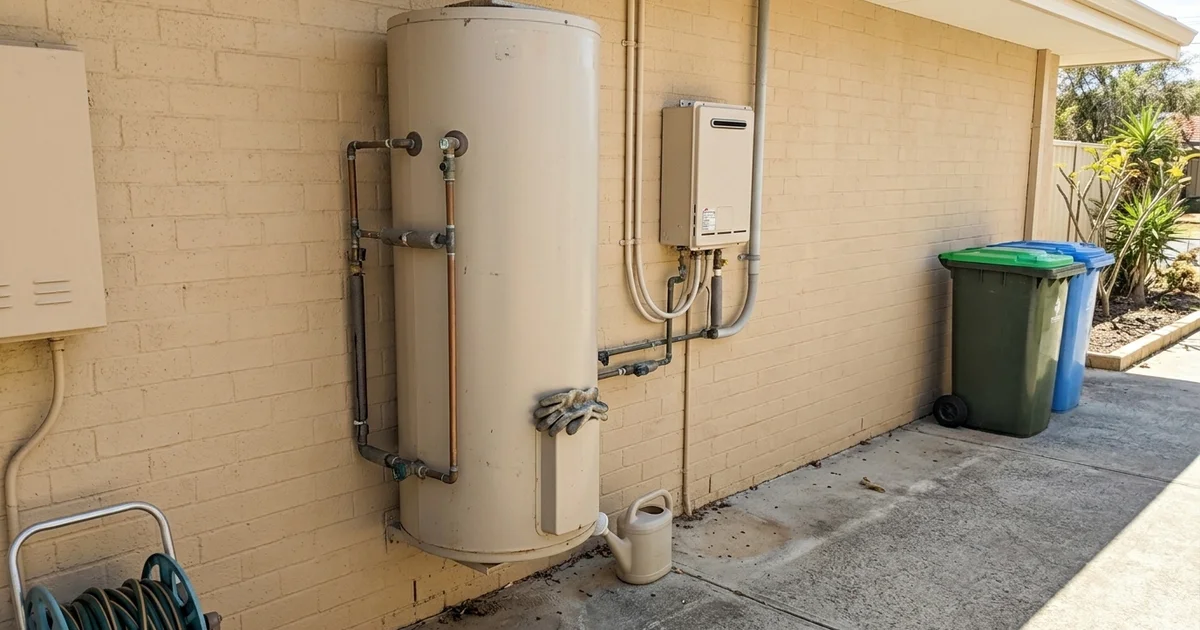
Two different answers to the same problem
Every hot water system solves one problem: getting water from mains temperature to shower temperature at the moment you want it. Storage and continuous flow take opposite approaches.
Storage heats a volume of water in advance and keeps it hot until you need it. When you turn the tap on, you draw from a reservoir that is already at temperature. The system then reheats what you used.
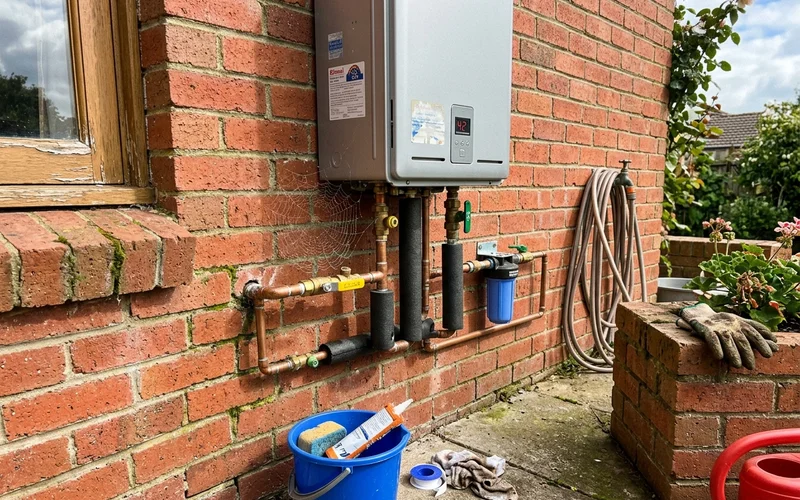
Continuous flow, also called instantaneous or tankless, heats nothing in advance. When you open a hot tap, water flows through a heat exchanger and comes out the other side at temperature, on demand, for as long as you keep the tap open.
Both work. Which one suits you comes down to space, demand pattern and what you value, and it is the first thing we settle on any hot water system installation quote.
Head to head
| Storage tank | Continuous flow | |
|---|---|---|
| Runs out | Yes, once the tank is drawn down | No, but flow rate is limited |
| Standby heat loss | Yes, 24 hours a day | None |
| Space needed | Substantial floor or ground footprint | Small wall-mounted box |
| Upfront cost | Lower | Higher |
| Install complexity | Lower | Higher, gas fitting and flueing |
| Simultaneous outlets | Excellent, up to the stored volume | Limited by litres per minute |
| Off-peak tariff | Compatible, and can be cheap | Not applicable |
| Energy sources | Electric, gas, solar, heat pump | Gas mostly, electric for small loads |
| Typical lifespan | 8 - 12 years | 15 - 20 years |
The case for continuous flow
It never runs out. For households where somebody always seems to get the last five minutes of lukewarm water, this alone settles it. Long showers, back-to-back showers, filling a bath after two people have showered, none of it drains a reservoir because there is no reservoir.
No standby losses. A storage tank radiates heat through its walls every hour of every day, whether anyone uses hot water or not, and the burner or element keeps topping it up. Continuous flow only consumes energy while water is actually flowing. Over ten years, that is a real number.
It takes almost no space. A wall-mounted unit the size of a small cupboard replaces a cylinder that occupied a chunk of the side setback or garage. In older Perth homes with narrow side passages, this is often the deciding factor.
Longer service life. With no cylinder full of heated water corroding from the inside, continuous flow units commonly run 15 to 20 years against 8 to 12 for a storage tank.
The case for storage
Very high simultaneous demand. A tank can deliver its full stored volume at once. Three showers plus a dishwasher off a large tank is fine, where a modest continuous flow unit would struggle. Beyond a point you can size continuous flow up or manifold two units, but the cost rises.
Lower upfront cost. Both the unit and the installation are cheaper for a storage system, particularly a like-for-like electric replacement with no gas fitting involved.
Works with any energy source. Solar and heat pump systems are storage systems by nature, because they generate heat gradually and need somewhere to put it. If you want the lowest running cost available, you are almost certainly getting a tank.
Off-peak tariffs. A large electric tank heated overnight on off-peak power can be surprisingly economical. It needs a bigger tank to carry a full day, but the energy is cheaper.
No gas required. If you have no mains gas, continuous flow becomes far less attractive, since whole-house instantaneous electric draws heavy current and usually needs switchboard work.
Sizing works completely differently
This is the part people most often get wrong when switching.
Storage is sized in litres. Roughly 125 to 170 litres of electric storage for a family of four on a continuous tariff, 250 to 315 litres on off-peak, less for gas because it recovers faster.
Continuous flow is sized in litres per minute. Around 16 L/min for one bathroom, 20 L/min for a typical two-bathroom family home, 26 L/min where multiple showers genuinely overlap.
Swapping a 250 litre tank for a 16 L/min continuous flow unit because “it never runs out” is how people end up disappointed. It genuinely never runs out, but it cannot serve two showers at once. Our guide on sizing your system goes through this properly.
One Perth-specific note: continuous flow output depends on how far the unit has to lift the water temperature, and mains inlet temperature is noticeably colder in July than February. A unit sized on summer performance can feel marginal in winter, so we size on the winter figure.
Which should you choose?
Choose continuous flow if you have mains natural gas, want endless hot water, are short on space, and your simultaneous demand is moderate.
Choose storage if you have very high simultaneous demand, no mains gas, a tight upfront budget, a genuine off-peak tariff, or if you are going solar or heat pump for the running-cost savings.
We install and size both across the Perth metro. See our hot water system installation page for what a compliant install includes, or have a look at continuous flow versus gas storage if you have already settled on gas.