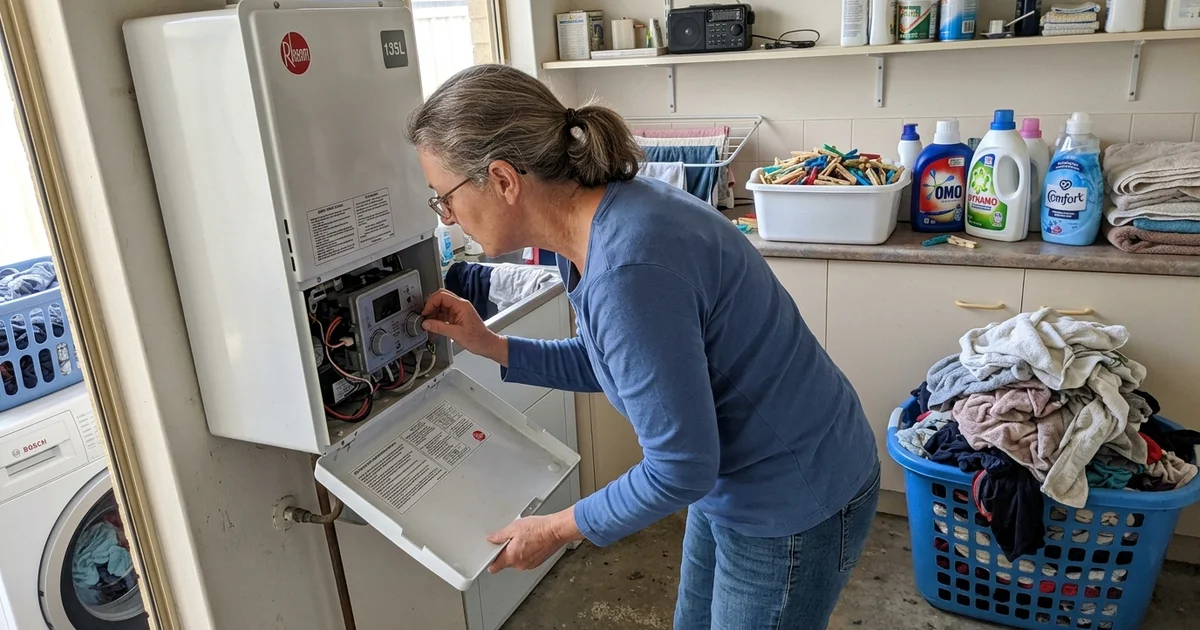
Start with the two-minute triage
Losing hot water without warning is one of those problems that feels catastrophic and is usually mundane. Before you call anyone, there are a handful of checks that take about two minutes and will tell you a lot about what you are dealing with.
Is it only the hot water, or is the water off entirely? Turn on a cold tap. If nothing comes out of that either, the problem is your water supply, not your hot water system.
Is anything leaking? Look at the ground under and around the unit, and at the wall behind it. Water pooling changes the situation entirely, and you should isolate the cold water valve and call 24/7 emergency hot water repairs rather than troubleshooting further.
Can you smell gas? If yes, stop. Turn the gas off at the meter, do not touch light switches, open doors and windows, and call immediately from outside.
Is the water lukewarm or stone cold? Lukewarm usually means the system is partly working, which points at one failed element on a dual-element tank, a failing thermostat, or a tempering valve problem. Stone cold points at a total failure of the heat source.
Everything after this depends on whether you have gas or electric, so it is worth knowing which you have. Gas bottles or a gas meter connected to the unit means gas. A thick electrical cable and a circuit labelled at your switchboard means electric.
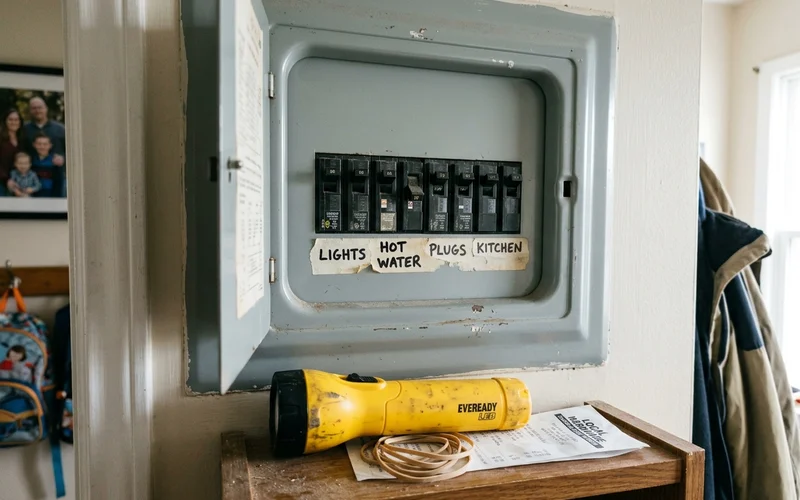
If you have an electric hot water system
A tripped circuit breaker. Go to your switchboard and look for a breaker labelled hot water, HWS or water heater. If it has flipped, reset it once. If it holds and the water comes back over the next few hours, you may have had a one-off. If it trips again straight away or later that day, there is a genuine fault, most commonly a shorted heating element, and it needs a licensed repair rather than another reset.
A burnt-out heating element. This is the most common electric fault by a wide margin. Elements typically last 5 to 10 years, and Perth’s harder water shortens that because scale builds on the element surface and makes it run hotter. On a dual-element tank, losing the bottom element gives you a small amount of hot water that runs out unusually fast, while losing the top element often leaves you with nothing at all.
A failed thermostat. The thermostat tells the element when to fire. When it fails you get no heat, or water that never quite reaches temperature. It is an inexpensive part and a quick swap.
An off-peak tariff you have forgotten about. If your system is on an off-peak circuit, it only heats overnight. Run through the whole tank on a big day and you genuinely will not have hot water again until the early hours. That is not a fault, it is a capacity problem, and the fix is a bigger tank or a different tariff.
If you have a gas hot water system
The pilot light has gone out. On older units with a standing pilot, this is the number one cause. Relight it once using the instructions on the unit. If it lights and then drops out again within minutes, or over the next day, the thermocouple is failing. That is the small sensor that tells the gas valve the pilot is lit, and when it weakens the valve shuts off the gas as a safety measure. It is a cheap part and a routine repair.
No gas supply. Obvious but worth checking. On LPG, look at your bottles, they may simply be empty or the changeover valve may not have switched. On mains natural gas, check whether your cooktop still lights.
A faulty gas control valve or ignition. Newer continuous flow units use electronic ignition rather than a pilot. If the unit is not firing at all, the fault could be the ignition, the gas valve, or a blocked burner. Insects nesting in the burner compartment are more common in Perth than people expect.
Water hot then cold on a continuous flow unit. Often means the unit is undersized for the number of outlets running, or that the burner is partially blocked and cannot maintain output.
When to stop and call someone
There is a clear line between checking and fixing. Relighting a pilot once, resetting a breaker once, and checking whether your LPG bottle is empty are all fine. Anything past that is licensed work.
Call straight away, at any hour, if you have water pooling under the unit, any smell of gas, no water at all in the house, or a breaker that trips repeatedly. Call during business hours if the system is simply not heating, the water is lukewarm, or the pilot will not stay lit after one relight attempt.
It also helps enormously if you can tell us the brand, the rough age from the compliance plate, and whether it is gas or electric when you book a plumber. That determines what we load on the truck, and it is often the difference between a one-visit fix and a return trip.
If your system is over ten years old and this is not the first fault, it is worth reading our guide on the signs a hot water system needs replacing before spending money on another repair.
Most no-hot-water calls turn out to be a single component: an element, a thermostat or a thermocouple. All three are inexpensive, all three are carried on our trucks, and all three are usually fixed on the first visit.